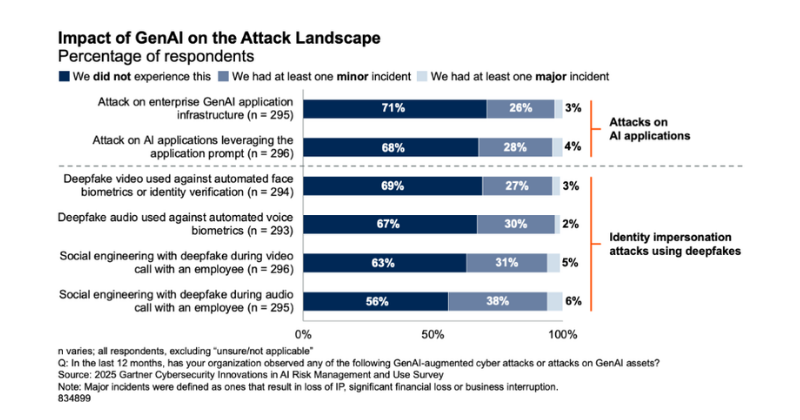
Source: Gartner (September 2025)
Additionally, IBM (via Ponemon Institute data) reports that 20% of organizations suffered breaches due to shadow AI, increasing breach costs by approximately $670,000 on average. These incidents frequently exposed sensitive data, including PII (65%) and intellectual property (40%).
Understanding the OWASP Top 10 for LLM Security
To address these emerging risks, the OWASP has introduced a Top 10 framework specifically for LLM and GenAI security.
Here are a few that show up most often in real-world environments:
Prompt Injection
This is one of the easiest ways to manipulate an AI system. Attackers craft inputs that override instructions and force the model to behave in unintended ways.
Sensitive Information Disclosure
Models can leak confidential data either from training data, or from connected systems especially when guardrails are weak.
Supply Chain
AI systems rely on multiple tools and integrations. A vulnerability in any one component can create entry points. We’ve already seen cases (like litellm PyPI supply chain attack) that accidently gave access to credentials and secrets. Simple practices like key rotation and access control go a long way here.
Improper Output Handling
Unvalidated AI outputs can lead to downstream vulnerabilities, especially when integrated into applications or workflows.
Vector and Embedding Weaknesses
If your system relies on embeddings or vector databases, attackers can poison data sources to influence responses.
Misinformation
This is less about attackers and more about the nature of GenAI itself. Models can sound confident even when they’re wrong and that can lead to bad decisions.
Unbounded Consumption
Without limits, GenAI systems can be abused leading to high costs, performance issues, or even denial-of-service scenarios.
Mitigation Strategies: Building Secure GenAI Systems
Enterprises must move from experimentation to secure, governed AI deployment. Below are key strategies:
01. Grounding with RAG (Retrieval-Augmented Generation)
Anchoring model responses to trusted enterprise data reduces hallucinations and improves accuracy.
02. Fine-Tuning
Customizing models on domain-specific datasets ensures relevance and controlled behavior.
03. Automated Validation Mechanisms
Implement output validation layers to detect anomalies, bias, or unsafe responses before delivery.
04. Secure Development Practices
Adopt secure coding standards aligned with OWASP ASVS, combined with a Zero Trust architecture. One must never assume inputs or systems are safe.
05. Logging, Monitoring & Anomaly Detection
Comprehensive observability is critical to detect misuse, prompt attacks, or abnormal behavior in real time.
06. Adversarial Robustness Training
Train models to withstand malicious prompts and adversarial inputs.
07. Graceful Degradation
Ensure systems fail safely returning controlled responses instead of exposing sensitive logic or data.
08. Input Validation & Secure Data Access
Use strict input validation and enforce parameterized queries or prepared statements for database interactions.
09. Guardrails
Deploy policy enforcement layers to restrict unsafe outputs and enforce compliance requirements.
10. Data Validation & Source Authentication
Ensure data integrity through validation, classification, and verification of trusted sources—especially in multi-system environments.
Turning Risk into Competitive Advantage
At Nallas, we believe that security is not an afterthought. It is embedded into every stage of the GenAI lifecycle.
From design and development to deployment and continuous monitoring, we integrate:
- Secure AI architecture patterns
- Real-time risk detection frameworks
- Enterprise-grade governance models
Our approach ensures that organizations can leverage GenAI confidently without compromising security, compliance, or trust.