

LLMOps Strategy Explained
Over the past couple of years, enterprises have rapidly embraced Generative AI. Teams are building copilots, document assistants, intelligent search systems, and autonomous workflows faster than ever before. In many cases, a proof of concept (PoC) can be built within days using foundation model APIs and modern orchestration frameworks.
But moving from a successful demo to a reliable production system is where most organizations begin to struggle.
A chatbot that performs well in a controlled environment may suddenly generate inaccurate responses in production. Retrieval pipelines start surfacing irrelevant information. Token consumption rises unexpectedly. Latency increases during peak usage. Security and compliance teams raise concerns around sensitive data exposure. What initially looked like a straightforward AI deployment quickly becomes an operational challenge.
This is exactly where LLMOps comes into play.
What is LLMOps?
LLMOps is the operational framework that supports the lifecycle of Large Language Model (LLM) applications in production environments. It includes everything that happens beyond the user simply interacting with a GenAI application.
From data analysis and preprocessing to observability, governance, monitoring, experimentation, evaluation, and optimization, LLMOps ensures that AI systems remain scalable, reliable, secure, and cost-efficient over time. Small changes in prompts, retrieval context, or model versions can significantly impact output quality. As organizations scale AI across business functions, operational maturity becomes just as important as model capability.
How to Build an LLMOps Pipeline
Building a successful GenAI application requires far more than simply connecting an LLM to a user interface. Behind every reliable AI system is an operational pipeline that continuously manages data, prompts, monitoring, governance, and optimization at scale.
Enterprise Generative AI Security
Generative AI (GenAI) is no longer experimental. It is operational. From automated code generation and intelligent document processing to customer service copilots and decision-support systems, enterprises are embedding GenAI across the entire service lifecycle. In modern AI consulting environments, GenAI spans everything from requirement analysis and architecture design to deployment automation, monitoring, and continuous optimization.
GenAI and the Reinvention of Enterprise Knowledge
Enterprise knowledge is abundant, but inaccessible. Buried in documents, emails, tickets, and tribal memory, it rarely reaches decision-makers when needed.
GenAI changes this by turning static knowledge into living intelligence.
The GenAI Control Plane – Why Governance Must Be Engineered, Not Enforced
As GenAI moves from pilots to production, enterprises face a new challenge: control at scale. Policies and guidelines alone are insufficient. Governance must be embedded into architecture. This is where the concept of a GenAI Control Plane emerges.
GenAI as an Enterprise Operating System
Most enterprises today treat Generative AI as a feature-embedded into chatbots, analytics tools, or copilots. But this framing is limiting. The next phase of adoption will redefine GenAI not as a tool, but as an enterprise operating system that orchestrates work across functions.
Just as ERP systems standardized finance and operations, GenAI is poised to become the intelligence layer that coordinates decisions, workflows, and execution.
GenAI-Powered Talent & Skills Transformation
GenAI-Powered Talent & Skills Transformation Author: Jerry Papadatos, Pranav Despande March 9, 2026 5 Mins read Share us on: The talent shortage in tech is real, and it’s growing. McKinsey projects a global shortfall of 85 million skilled workers by 2030. GenAI isn’t just an automation tool; it’s a skills accelerator that can help enterprises […]
From LLMs to Multi-Modal AI: The Next Leap in Enterprise AI
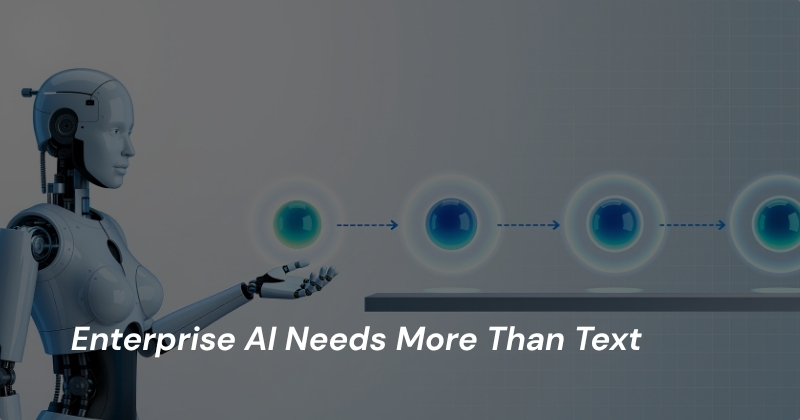
Large language models (LLMs) like GPT-4 changed the game by mastering text. But enterprises don’t live in a text-only world. They operate with diagrams, images, videos, audio logs, and code. That’s why the future isn’t just LLMs; it’s multi-modal AI.
The Future of GenAI in Enterprise Data Analytics
For decades, business intelligence (BI) meant dashboards, KPIs, and drill-downs. But in a world where executives demand instant, context-rich answers, dashboards alone aren’t enough. Enter Generative AI: the bridge between data and decision.
GenAI for Responsible & Ethical AI Adoption
The excitement around Generative AI (GenAI)is undeniable. But as enterprises rush to deploy copilots and agents, one question looms larger than ever: Can we trust AI?
Responsible AI isn’t just about regulatory compliance, it’s about ensuring that GenAI solutions are transparent, unbiased, and aligned with organizational values. At Nallas, we believe the future of enterprise AI will be defined not by who adopts fastest, but by who adopts most responsibly.
Data Foundations for GenAI: Why Good AI Starts with Good Data
The GenAI conversation often begins with models like GPT-4, Llama, Claude and their breathtaking ability to generate code, images, or strategy decks. But ask any enterprise deploying GenAI at scale, and a different truth emerges: it’s not the model, it’s the data.