The distinction is important because many organisations are attempting to place AI on top of architectures that were never designed to support it.
Adding a model to an existing data estate does not automatically create an AI-ready enterprise.
If the underlying data is fragmented, the model receives fragmented context.
If the data is stale, the model reasons over stale information.
If business definitions are inconsistent, the model inherits those inconsistencies.
If lineage and governance are weak, autonomous systems simply increase the scale at which those weaknesses can operate.
The problem therefore sits deeper than the AI application.
It sits underneath it.
Enterprises Do Not Have a Data Shortage. They Have a Context Problem.
Enterprise data has never been more abundant.
Applications generate transactional data. Devices generate telemetry. Customer interactions generate behavioural signals. Documents contain operational knowledge. APIs expose external information. Streaming systems capture events as they happen.
The problem is not access to information.
The problem is whether that information can be assembled into trusted business context.
A customer record sitting in one system, a transaction in another, a service interaction in a third and an unstructured document in a fourth may all describe the same business reality.
But an AI system does not automatically understand that relationship simply because the data exists.
The valuable asset is no longer simply the record.
It is the relationship between the record, its meaning, its origin, its freshness, its business context and the decision to which it contributes.
That makes context an architectural concern.
Semantic layers, metadata, lineage, data products, governance and retrieval mechanisms are therefore becoming increasingly important to AI architecture.
The enterprise question is moving from:
“Where is the data?”
to:
“Can the system understand what this data means, whether it can trust it and how it should be used?”
That is a much harder engineering problem.
And it is becoming one of the most important.
Real-Time Is Becoming a Requirement for Correct Decisions
For years, real-time data was primarily associated with performance.
Faster dashboards. Faster alerts. Faster operational reporting.
The AI era changes the significance of time.
For an intelligent system making or recommending an action, freshness can determine whether the decision is correct at all.
A fraud model evaluating an old transaction history is fundamentally different from an intelligence system evaluating an event as it occurs.
A healthcare application working with delayed patient signals operates differently from one receiving continuous device data.
An insurance workflow using yesterday’s information operates differently from one responding to a newly reported event.
A customer intelligence system that knows what happened last week is useful.
A system that understands what is happening now can become operational.
This is why streaming, change-data capture, event-driven architectures and real-time processing are becoming strategic components of modern data platforms.
Real-time data is no longer simply about making dashboards refresh faster.
It is becoming the temporal dimension of intelligence.
The architecture has to understand not only what happened, but when it happened — and whether that timing changes the decision.
The Data Platform Is Becoming the Control Plane for AI
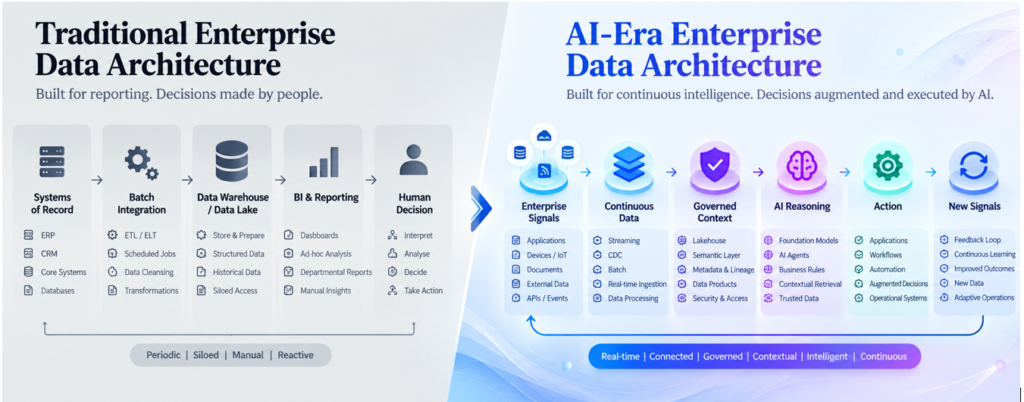
The traditional data platform was largely a place where information was stored, transformed and made available for analysis.
The emerging enterprise data platform has a much larger responsibility.
It increasingly determines what information an AI system can access, which information can be trusted, how business meaning is represented, where data originated, how recently it was updated, which policies govern its use, what actions can be taken from it and how those actions can be observed.
This changes the role of governance.
Governance cannot be bolted onto an AI initiative after deployment.
It has to be engineered into the underlying data architecture.
As organisations move towards AI agents and increasingly autonomous workflows, this becomes even more important.
An enterprise agent needs more than access to information.
It needs controlled access. It needs context. It needs business rules. It needs traceability. It needs observable actions.
And the organisation needs to understand why a system reached a particular conclusion or initiated a particular action.
That makes the data platform less of a backend utility and more of a control plane for enterprise intelligence.
The Pipeline Is Disappearing Into the Platform
Another significant change is taking place inside data engineering itself.
The traditional pipeline model assumes that engineers define a sequence of transformations, schedule those processes and maintain them as source systems change.
That model becomes increasingly difficult to scale as data estates become more heterogeneous and the number of AI workloads increases.
The next generation of data platforms is beginning to automate more of the engineering lifecycle.
Schema changes can be detected. Data quality issues can be identified. Dependencies can be understood. Pipeline failures can be diagnosed. Transformation logic can be assisted. Data can be discovered and classified. Workflows can increasingly respond to conditions rather than simply execute schedules.
This does not eliminate data engineering.
It changes its altitude.
Engineers spend less time manually moving individual datasets and more time designing the architecture, controls, semantics and operating models that allow intelligent data systems to function reliably.
The pipeline does not disappear because data stops moving.
It disappears as the primary abstraction.
The platform becomes increasingly responsible for understanding how data should move, transform, govern and serve the enterprise.
Data Engineering and AI Infrastructure Are Converging
The separation between “data infrastructure” and “AI infrastructure” is becoming increasingly artificial.
AI needs data. But it needs more than data.
It needs fresh data. It needs structured and unstructured information. It needs metadata. It needs semantic relationships. It needs governed access. It needs observability. It needs retrieval. It needs reliable pipelines. It needs a platform capable of serving both analytical and operational workloads.
That means the architecture supporting an AI application increasingly extends deep into the data engineering layer.
The AI stack is therefore expanding downward.
What looks like an AI problem at the application layer is often a data engineering problem underneath.
And what looks like a data engineering problem increasingly has an AI requirement attached to it.
The two disciplines are converging around a common objective: creating reliable, contextual and continuously available enterprise intelligence.
From Data Pipelines to Intelligence Loops
The most important architectural shift may ultimately be this:
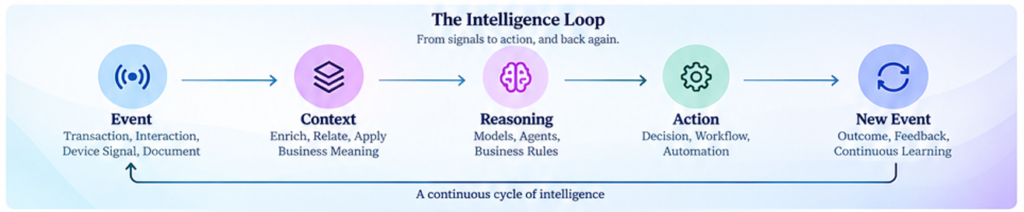
The enterprise is moving from data pipelines to intelligence loops.
A pipeline has a beginning and an end.
A signal enters. It is processed. A result is produced.
An intelligence loop behaves differently.
An event occurs. The system gathers context. AI reasons over that context. An action is initiated. That action creates another signal. The system learns from the new state. And the cycle continues.
This architecture has significant implications for how enterprises think about data engineering.
The objective is no longer simply to make data available.
It is to make enterprise intelligence continuous.
That requires architectures capable of connecting systems, events, context, governance and action without breaking the chain between them.
It also changes the economics of data.
A well-engineered data foundation is no longer supporting only dashboards and reports.
It can support decision engines, AI agents, operational applications, customer experiences and autonomous workflows.
The same trusted context can become infrastructure for multiple forms of intelligence.
That is where the strategic value begins to compound.
The Nallas Perspective
At Nallas, this is where the conversation around data engineering becomes broader than pipeline modernisation.
The objective is not to create another destination for enterprise data.
It is to change the way enterprise data can participate in the operating model of the business.
That means modernising data estates where legacy architecture constrains analytical and AI workloads. It means engineering real-time pipelines where the timing of information affects the business outcome. It means establishing governance, lineage and data quality before intelligent systems begin consuming enterprise data at scale.
It also means creating reusable data products and contextual layers rather than exposing AI systems to an uncontrolled collection of tables, files and disconnected sources.
Nallas works across modern data engineering, cloud-native data architectures, Databricks, lakehouse modernisation, real-time data, data governance and AI transformation to help enterprises build this foundation.
As a Databricks Consulting Partner, Nallas brings together lakehouse architecture, data engineering, real-time analytics, governance and AI capabilities to modernise enterprise data environments.
The same architectural principle extends into Nallas’ Agentic AI Data Fabric through Arivonix — connecting heterogeneous enterprise sources, establishing governed data foundations and making data operations increasingly intelligent.
The technology matters.
But the architectural outcome matters more.
Enterprise data that can move, understand, govern and participate in decisions.
The AI Ceiling Will Be Defined by What Sits Beneath the Model
The technology industry has spent the last several years asking how capable AI models can become.
The more consequential enterprise question is now emerging:
How capable is the architecture surrounding those models?
A powerful model cannot compensate for fragmented enterprise context.
An autonomous agent cannot compensate for stale information.
A sophisticated AI application cannot compensate for weak governance.
And another pipeline cannot solve an architectural problem created by hundreds of disconnected systems.
The next generation of enterprise AI will therefore not be won by model capability alone.
It will be won by organisations that can turn fragmented signals into trusted context — continuously, securely and at operational speed.
That makes data architecture a strategic AI capability.
The boundary between data engineering and AI infrastructure is already beginning to disappear.
What remains is the architecture underneath both.
Build that architecture well, and AI becomes an operating capability.
Build it poorly, and AI remains a collection of impressive demonstrations.
The future of enterprise intelligence will be determined by what organisations build beneath the model.