For years, warehouse automation was largely about making existing processes faster. Forecast demand, optimize inventory, route a vehicle, assign a worker, move a package. AI is changing that model. The warehouse of the future is increasingly expected to sense what is happening, understand the situation, decide what should happen next and, in some cases, act on that decision.
Recent industry research points to four broad stages of AI adoption in warehousing: advanced optimization, operational generative AI, semi-autonomous agents and physical AI. Together, they show how warehouse intelligence is moving from software that recommends actions toward systems that can execute them. But the real transformation is not about adopting four different types of AI. It is about building an architecture that allows them to work together.
AI is moving beyond optimization
Traditional warehouse AI has focused heavily on optimization. Demand forecasting, inventory planning, workforce scheduling, slotting and route optimization can all use historical and real-time data to continuously improve operational decisions. The next step is making those systems more responsive. Instead of relying on a plan created earlier in the day, an intelligent warehouse can react when order volumes change, equipment goes offline or staffing levels shift.
This is where richer operational data becomes important. Warehouse management systems, sensors, equipment telemetry, inventory systems and order data all provide pieces of the picture. AI becomes more useful when those pieces can be interpreted together.
Generative AI adds an operational layer
Generative AI introduces a different capability. Warehouses contain large amounts of unstructured information that traditional optimization systems do not easily consume, including maintenance records, incident reports, supplier documents, work instructions, safety procedures and operational notes. Generative AI can turn this information into context-specific instructions, summaries and recommendations.
A supervisor dealing with an equipment issue, for example, could receive an explanation based on the machine’s current status, previous incidents and relevant maintenance documentation instead of searching through several systems manually. The value is not the chatbot. The value is connecting operational knowledge to the moment a decision needs to be made.
Agents take AI from recommendation to execution
The bigger shift happens when AI begins managing multi-step workflows. An agent can monitor warehouse conditions, identify an exception, evaluate possible responses and recommend a sequence of actions. With appropriate controls, parts of that workflow can eventually be executed automatically.
For example, a sudden increase in high-priority orders could trigger a chain of decisions: reprioritize picking tasks, reallocate available workers, adjust robot assignments, change staging priorities and escalate capacity constraints. The important architectural distinction is that an agent should not simply have unrestricted access to operational systems. It needs defined permissions, structured tools, clear decision boundaries, validation and human escalation for situations that require judgment. As AI becomes more capable of acting, control becomes just as important as intelligence.
Physical AI closes the loop
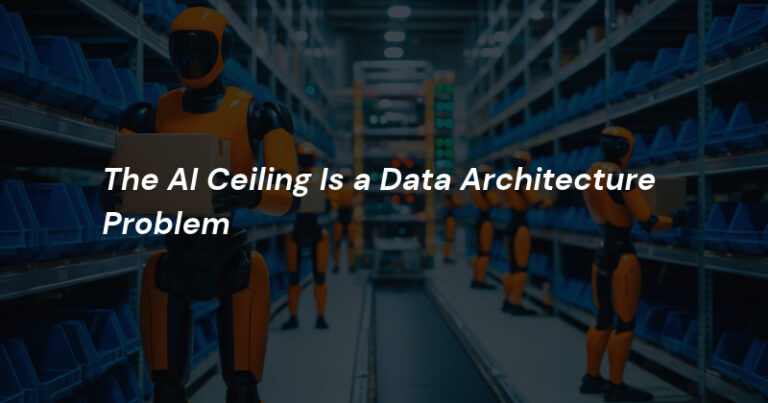
The final step is where digital intelligence meets the physical environment. Robots can already support picking, sorting, packing and material movement. The emerging shift is toward systems that can perceive changing environments and adapt their actions instead of following only predefined instructions.
This creates a very different architecture. The AI system now has to deal with sensors, robotics, edge computing, real-time decisions, physical constraints and safety. A warehouse agent might decide that a task needs to be reprioritized. A robotic system then needs to execute that decision within the physical constraints of the facility. That means enterprise AI can no longer be designed as an isolated model sitting on top of a database. It becomes a connected operational system.
The missing layer: orchestration
This is where many AI discussions become too focused on the model. A warehouse could have excellent forecasting, capable agents and sophisticated robots and still perform poorly if those systems cannot coordinate.
The architecture needs to connect:
Enterprise data → AI models → agents → operational systems → physical machines
And the flow needs to work in both directions. The warehouse sends information to the AI. The AI makes a decision. The decision reaches the appropriate system. The physical or digital operation changes. New information comes back. The system evaluates what happened and continues from there. This creates a closed operational loop.
Digital twins and simulation can add another layer by allowing organizations to test layouts, workflows and robotic strategies before making changes to the physical environment. Research in 2026 continues to highlight digital twins as an important component of AI-enabled warehouse optimization.
Humans are still part of the architecture
Autonomous does not necessarily mean human-free. In many warehouse environments, the more practical model is human and AI working together. AI can continuously monitor operations and handle predictable decisions. People can remain responsible for exceptions, safety-sensitive situations and decisions where business context matters.
This distinction becomes increasingly important as AI moves closer to physical execution. A system that can recommend an action and a system that can physically execute that action should not necessarily have the same level of autonomy. The architecture needs to reflect that difference.
What enterprises should consider
The question for organizations is therefore not, “Where can we add AI to the warehouse?” A better question is, “Which decisions should AI make, which should humans make, and which actions should machines execute?”
That leads to a more practical architecture. Start with proven optimization problems where the outcome can be measured. Add generative AI where unstructured operational knowledge is slowing decision-making. Introduce agents where workflows involve multiple decisions and systems. Use physical AI where the environment, economics and safety requirements justify automation. Then connect these capabilities through a controlled orchestration layer.
The progression does not have to happen all at once.
The real opportunity is intelligent operations
The warehouse is becoming a useful example of where enterprise AI is heading more broadly. AI is moving from answering questions to influencing decisions, and from influencing decisions to taking action.
That shift changes what enterprises need from their AI architecture. Models matter. But so do data pipelines, real-time context, system integrations, orchestration, permissions, observability, simulation, edge infrastructure and human oversight.
The organizations that benefit from this transition will not necessarily be the ones deploying the most advanced model. They will be the ones that can connect intelligence to the operational environment in a controlled, measurable way.
At Nallas, we help organizations evaluate AI workloads, design the right architecture across data, models, infrastructure and orchestration, and build AI systems around the workflows they actually need to improve.