Why does the member experience keep breaking down?
Association technology leaders are not short of tools. Over the past decade, most have accumulated an AMS, a CRM, a community platform, a learning management system, an events engine, a content library and a support desk. Each was bought to solve a real problem, and each does its job. The difficulty is that members do not experience these systems one at a time. They move across them.
A member renews, then registers for an event, then searches for a certification, then contacts support when that search fails. The friction almost never lives inside a single system; it lives in the handoffs between them.
The friction is rarely inside a system. It lives in the handoffs between them.
This is why rising support volume is so often misread as a staffing problem when it is really a self-service failure, and why portal adoption can look strong while requests keep climbing. The systems may be available, integrated and performing exactly as designed, and members still abandon tasks, repeat information and contact staff unnecessarily.
AI was supposed to close this gap. In practice, most associations remain stuck in experimental pilots. An assistant answers a narrow set of questions, or a chatbot handles a single workflow, but the moment a member need crosses systems, the AI cannot follow. The pilot works in the demo and fails in the lifecycle. The problem is rarely the model. It is that the organisation has no operational layer capable of coordinating intelligence across its fragmented sources.
Does becoming AI-driven require a big, expensive leap?
The most common objection is cost. Leaders assume that becoming an AI-driven organisation means replacing core systems, hiring a data science team and committing a budget most associations do not have. That assumption is precisely what keeps them frozen at the pilot stage.
The reality is that execution maturity is not a single leap. It is a progression, and the progression is not even strictly linear. Organisations can and do move between stages depending on technology investment, process maturity and strategic priority. What matters is understanding the current state and the specific gap to the next stage.
The transition toward continuous engagement does not require a full technology overhaul.
Organisations can begin incrementally by layering orchestration and agent capabilities onto existing systems and prioritising a small number of high-impact member workflows.
What are the five stages of the Agentic AI Maturity Model?
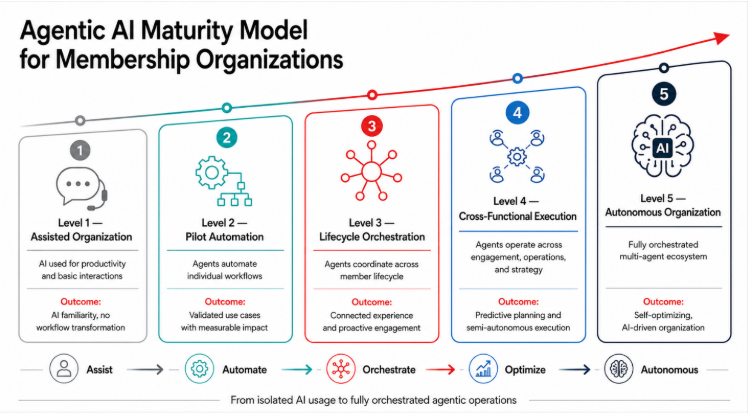
The Agentic AI Maturity Model for membership organisations describes five stages of execution maturity, moving from isolated AI usage to fully orchestrated agentic operations. The stages are a diagnostic, not a scoreboard: the goal is not to reach Stage 5, but to understand where you are and what the next deliberate step should be.
Stage 1 — Assisted Organisation
AI supports individuals and tools assist with tasks, but humans retain full control of every decision and action. There is AI familiarity but no workflow transformation.
What to do: build familiarity, identify the repetitive tasks worth automating, and establish the data hygiene that every later stage depends on.
Stage 2 — Pilot Automation
Isolated workflow automation, where specific, contained workflows are automated within individual functions. This is where most associations sit today.
What to do: validate use cases with measurable impact rather than proliferating disconnected pilots, and document exactly where each automation stops at a system boundary.
Stage 3 — Lifecycle Orchestration
Agents coordinate execution across the member lifecycle. This is the critical inflection point where fragmented automation converges into continuous, behaviour-driven engagement, producing a connected experience and proactive engagement.
What to do: connect two or three high-impact workflows across systems, and instrument the handoffs where members currently drop off.
Stage 4 — Cross-Functional Execution
Organisation-wide alignment, where agents operate across functions, sharing signals and coordinating responses at the enterprise level across engagement, operations and strategy.
What to do: unify signals across departments and shift from reactive support to predictive planning and semi-autonomous execution.
Stage 5 — Autonomous Organisation
A fully orchestrated multi-agent ecosystem in which the system learns, adapts and refines its own execution model based on outcomes, with minimal human configuration.
What to do: govern, monitor and set the guardrails within which the system is allowed to self-optimise.
The important thing is the gap, not the label. An organisation at Stage 2 does not need to reach Stage 5. It needs to understand what is blocking the jump to Stage 3, because that is where connected experience and proactive engagement actually begin.
How do I get started without overcommitting?
Getting started is less about technology selection and more about honest diagnosis. Before evaluating a single new tool, three questions are worth answering: which member journeys cross the most systems, where do members most often abandon a task, and which support tickets should never have been created because the answer already existed somewhere in your stack.
To make that diagnosis concrete, we built a short assessment around the five stages. It takes about five minutes and returns the stage your organisation currently occupies, along with the specific gap to the next one.
Take the five-minute Membership Agentic Maturity Review.
What is the takeaway for an association technology leader?
The goal was never to adopt AI. It was to deliver a member experience that does not break down between systems. AI maturity is simply the operational path to that outcome, and it is walked one stage at a time.
The organisations that pull ahead will not be the ones with the largest budgets. They will be the ones that know exactly where they stand and take the next deliberate step. Start by finding out which stage you are in.
Frequently Asked Questions (FAQs)
1) What is the Agentic AI Maturity Model for membership organisations?
It is a five-stage framework that describes how a membership organisation progresses from isolated AI usage to fully orchestrated agentic operations. Each stage defines a level of execution maturity and the outcome it produces, from basic AI familiarity through to a self-optimising, autonomous organisation. It is used as a diagnostic to locate where an organisation is today and what the specific gap to the next stage is.
2) Why do most association AI pilots fail to scale?
Pilots usually fail not because the underlying model is weak, but because the organisation has no operational layer to coordinate intelligence across systems. A pilot answers a narrow question or handles one workflow, but the moment a member need crosses systems, the AI cannot follow. Scaling requires orchestration across the member lifecycle, which is a later stage of maturity than a single pilot represents.
3) What are the five stages of AI execution maturity?
The five stages are Assisted Organisation, Pilot Automation, Lifecycle Orchestration, Cross-Functional Execution and Autonomous Organisation. They move from humans retaining full control of AI-assisted tasks, through isolated automation, to coordinated execution across the lifecycle, then enterprise-wide agent coordination, and finally a self-optimising system with minimal human configuration.
4) What does an Assisted Organisation mean in the AI maturity model?
An Assisted Organisation, Stage 1, uses AI to support individuals and assist with tasks while humans retain full control of every decision and action. There is AI familiarity but no genuine workflow transformation yet. The priority at this stage is building familiarity, spotting repetitive tasks worth automating, and getting data hygiene in order.
5) What is the difference between workflow automation and lifecycle orchestration?
Workflow automation, Stage 2, automates specific, contained tasks inside a single function, and each automation typically stops at a system boundary. Lifecycle orchestration, Stage 3, coordinates execution across the member lifecycle so that fragmented automations converge into one continuous, behaviour-driven experience. The difference is scope: automation works within a system, orchestration works across them.
6) Why is Stage 3 considered the critical inflection point?
Stage 3, Lifecycle Orchestration, is where organisations move from automation within workflows to orchestration across the member lifecycle. It is the point at which isolated automation converges into continuous, behaviour-driven engagement, producing a connected experience and proactive engagement rather than a set of disconnected wins. It is the stage where the member experience stops breaking down in the gaps between systems.
7) How much does it cost to move up the AI maturity stages?
Moving up the stages does not require a large upfront budget or a full technology overhaul. Organisations can progress incrementally by layering orchestration and agent capabilities onto existing systems and prioritising a small number of high-impact member workflows. Cost is far less of a constraint than clarity about the current stage and the next step.
8) Do we need to replace our AMS or CRM to become AI-driven?
No. The maturity model is explicitly designed to layer onto existing systems rather than replace them. Progress comes from orchestrating and connecting the systems already in place, not from ripping out the AMS, CRM or community platform. A full replacement is neither required nor recommended as a starting point.
9) How do I know which AI maturity stage my association is in?
You can identify your stage by examining how AI is used today: whether it merely assists individuals, automates isolated workflows, orchestrates across the lifecycle, coordinates across functions, or self-optimises. A quick way to place yourself accurately is to take a short assessment built around the five stages, which returns your current stage and the specific gap to the next one.
10) What should an association at Stage 2 do next?
An organisation at Stage 2, Pilot Automation, should resist proliferating more disconnected pilots and instead focus on the jump to Stage 3. That means validating use cases with measurable impact, documenting where automations stop at system boundaries, and then connecting two or three high-impact workflows across systems while instrumenting the handoffs where members drop off.
11) What is the Cross-Functional Execution stage in practice?
Cross-Functional Execution, Stage 4, is organisation-wide alignment where agents operate across functions, sharing signals and coordinating responses at the enterprise level. In practice it means engagement, operations and strategy draw on the same signals, enabling predictive planning and semi-autonomous execution rather than reactive, siloed responses.
12) What does an Autonomous Organisation actually look like?
An Autonomous Organisation, Stage 5, runs as a fully orchestrated multi-agent ecosystem that continuously optimises itself, learning, adapting and refining its own execution model based on outcomes with minimal human configuration. The human role shifts from operating the system to governing it, setting guardrails and monitoring the outcomes within which it self-optimises.
13) Why do support tickets keep rising even when portal adoption is strong?
Rising support volume alongside strong adoption usually signals a self-service failure rather than a staffing or demand problem. It often means members could not find or complete what they needed inside the portal and escalated to staff as a fallback. Read that way, support volume becomes a useful measure of where the digital experience breaks down.
14) How long does it take to move from one maturity stage to the next?
There is no fixed timeline, because progression is not strictly linear and depends on technology investment, process maturity and strategic priority. Organisations can move between stages at different speeds, and the fastest progress usually comes from focusing on a small number of high-impact workflows rather than attempting everything at once. The gap to the next stage matters more than the calendar.
15) How do I get started with agentic AI without a large budget?
Start with honest diagnosis rather than tool selection: identify which member journeys cross the most systems, where members abandon tasks, and which support tickets should never have existed. Then layer orchestration onto existing systems for two or three high-impact workflows. A five-minute maturity assessment is a low-cost way to pinpoint your stage and the single most valuable next step.