Every membership CEO reviews renewal reports. Far fewer ask a more important question.
When did we first know this member was leaving?
That distinction changes everything.
Renewal is often treated as the primary health metric for an association. Board reports revolve around renewal percentages. Leadership meetings celebrate or worry about month-end renewal numbers. Annual strategic plans target improvements in retention.
Yet renewal is not the event that determines whether a member stays.
It is simply the moment when the organization finally discovers the decision the member has been making for months. By the time renewal becomes visible, the opportunity to influence that decision has often disappeared. That is why renewal should be viewed as a lagging indicator rather than a leading one.
The organizations that consistently outperform on retention are rarely better at processing renewals. They become better at recognizing disengagement while it is still reversible.
The Invisible Story Behind Every Renewal
Imagine two CEOs looking at identical renewal dashboards.
Both see that membership renewal has declined from 91% to 84%. Both launch retention campaigns, both send reminder emails and both ask membership teams to call at-risk members.
One organization recovers most of those members. The other continues losing them.
The difference is not the renewal campaign. The difference is whether the organization understood what happened six months earlier.
Member behaviour rarely changes overnight. Attendance slowly declines, communities stop receiving contributions, professional development courses remain unfinished, certification progress slows, committee participation becomes irregular, support requests increase, website visits become less frequent and event registrations disappear.
None of these signals individually indicate resignation. Collectively, they tell a remarkably accurate story.
The problem is not the absence of data. The problem is that most organizations never assemble those signals into a coherent picture.
Many associations already possess thousands of behavioural data points spread across learning systems, AMS platforms, event software, community platforms, certification databases and customer support systems. The challenge is rarely collection. It is interpretation and coordinated action. Digital transformation research across the nonprofit sector consistently shows that disconnected systems and fragmented data prevent organizations from making timely operational decisions.
A Member Who Never Complained
Consider a hypothetical member named Sarah.
She joined five years ago. She attends conferences regularly, volunteers occasionally, completes certification programs, actively participates in online communities and has always renewed.
Then things begin changing.
She skips a webinar – no one notices. She stops participating in community discussions – still nothing happens. Her certification expires – no follow-up. She attends no events that year.
Marketing continues sending the same promotional newsletters. She opens fewer emails. Nobody connects the pattern. By the time the renewal invoice arrives, Sarah has already mentally left.
The renewal reminder simply formalizes a decision she reached months earlier. From the association’s perspective, Sarah became a non-renewal. From Sarah’s perspective, she stopped receiving enough value long before that.
Renewal was never the problem. It was the final symptom.
Most CEOs Already Have the Signals
The uncomfortable reality is that most associations already possess enough information to identify disengagement much earlier. They simply lack the operating model that converts information into intervention.
Think about where engagement already exists. Learning platforms record course completion, event platforms measure attendance, communities reveal participation, CRM systems capture interactions, support systems record service history, payment systems show purchasing behaviour.
Every one of these systems contains part of the story. Very few organizations combine them into a continuous understanding of member health. Instead, executives receive retrospective reports describing what already happened.
The strongest membership organizations build visibility around what is beginning to happen. That shift changes the conversation from reporting outcomes to influencing outcomes.
Measuring the Right Capability
Rather than asking whether renewal rates are good, CEOs should ask a different question.
Can our organization identify declining engagement early enough to change the outcome?
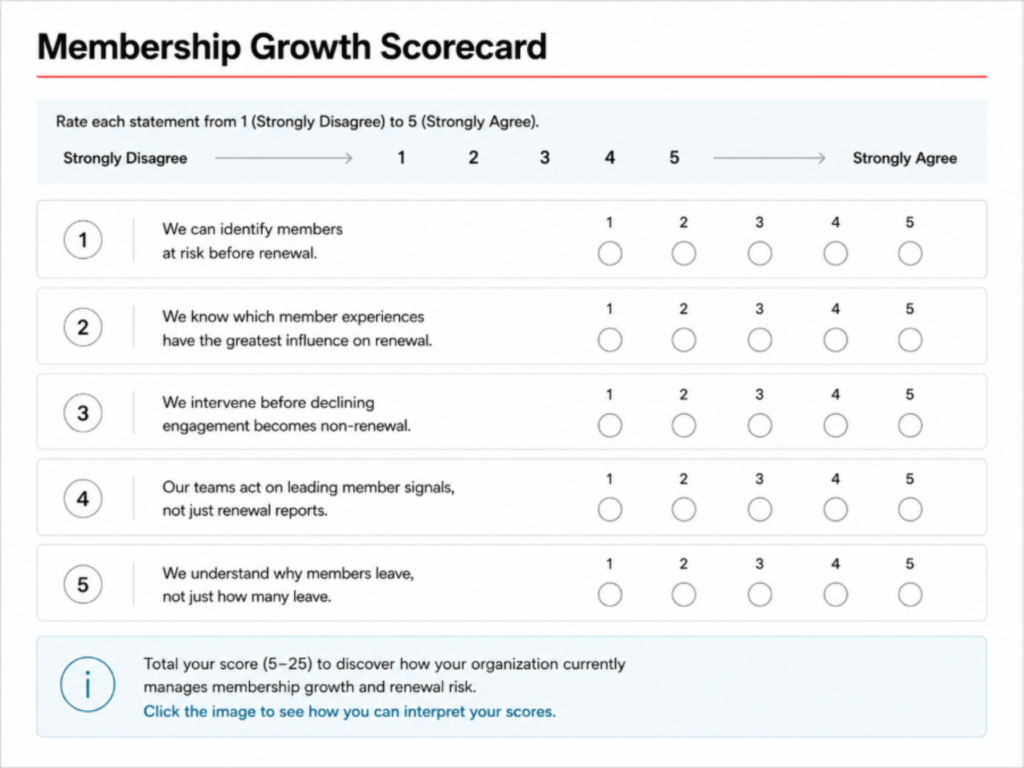
That is exactly what the Membership Growth Scorecard is designed to assess. The assessment does not measure technology maturity. It does not evaluate AI readiness.
It evaluates whether your organization consistently recognizes leading indicators of renewal risk.
The five questions focus on practical operating capabilities:
Five minutes is enough to produce a practical snapshot of how proactively your organization manages member engagement.
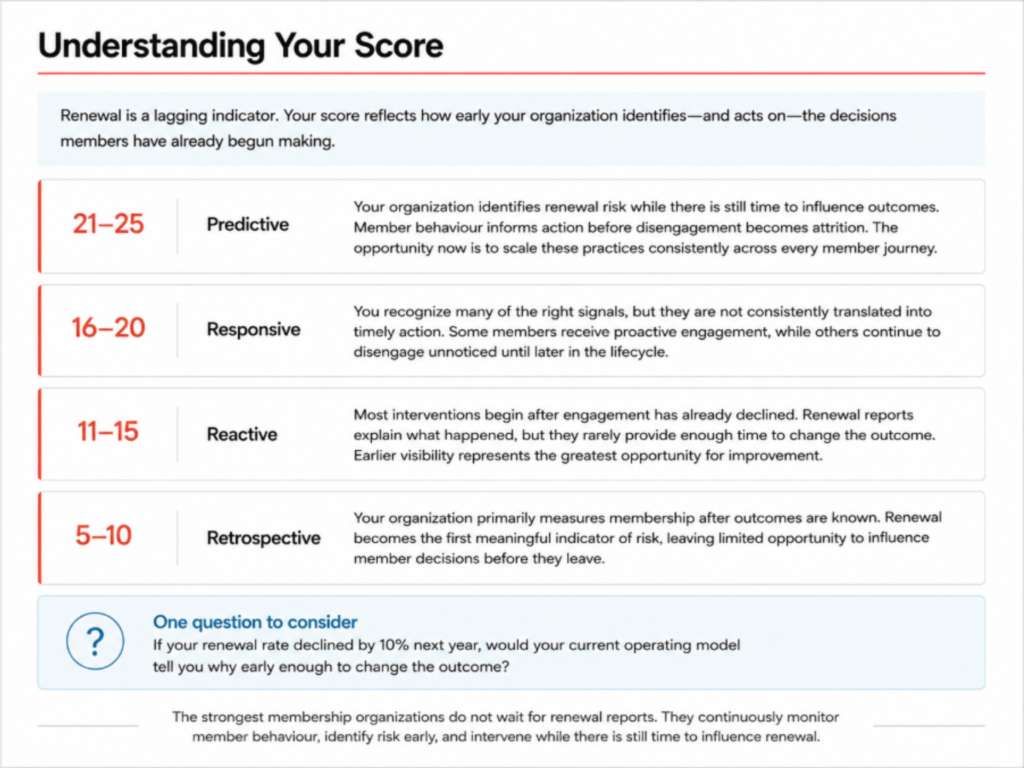
The accompanying interpretation guide places organizations into four broad operating profiles.
Organizations at the lower end primarily explain historical outcomes. Organizations at the higher end consistently detect behavioural change while there is still time to influence it.
The objective is not achieving a perfect score. The objective is understanding where operational improvements will have the greatest impact.
Why This Matters Even More Now
Member expectations continue evolving. Personalized digital experiences have become the standard across nearly every industry. Members increasingly expect organizations to recognize context, anticipate needs and provide timely support rather than generic communication.
At the same time, nonprofit technology is rapidly shifting toward AI-assisted decision support and intelligent operational workflows. Industry research shows growing movement toward conversational data, autonomous CRM capabilities and AI systems that proactively surface engagement opportunities rather than waiting for manual analysis.
That evolution makes one capability increasingly valuable. Knowing which member needs attention today. Not next quarter. Not after renewal reports. Today.
From Reporting to Influence
Every CEO wants stronger renewal rates. The organizations achieving them rarely begin with renewal. They begin with visibility. They understand engagement as it develops. They recognize behavioural patterns before they become financial outcomes. They equip teams to intervene while members are still deciding.
Renewal then becomes something very different. Instead of measuring whether members stayed, it validates that earlier decisions throughout the year were effective. That is a fundamentally different operating model.
And it starts with a simple question.
If renewal declined by 10% next year, would your organization know why early enough to change the outcome?
If the answer is uncertain, the Membership Growth Scorecard provides a practical place to begin.
Frequently Asked Questions (FAQs)
1) Why is renewal considered a lagging indicator?
Because renewal confirms a decision that members have often been making over several months through changes in engagement behaviour.
2) What are leading indicators of member disengagement?
Reduced event participation, declining learning activity, fewer community interactions, lower portal usage, reduced email engagement, declining purchases and fewer support interactions are common examples.
3) Can associations predict renewal risk?
Yes. When behavioural signals are connected across systems, organizations can identify patterns that frequently precede non-renewal.
4) Does this require artificial intelligence?
No. Many organizations can significantly improve visibility through better integration and reporting before introducing AI.
5) What is the biggest obstacle?
Most organizations store engagement data in multiple disconnected systems that rarely communicate with one another.
6) Is renewal prediction only useful for large associations?
No. Smaller associations often benefit even more because proactive intervention can be highly personalized.
7) How often should renewal risk be monitored?
Continuously. Member engagement changes throughout the year, not only during renewal season.
8) Should membership teams own this process?
Membership teams play a major role, but marketing, education, events, customer support and technology all contribute valuable engagement signals.
9) How accurate are behavioral signals?
Individual signals are weak predictors. Multiple signals observed together become significantly more reliable.
10) How long before renewal do members typically disengage?
It varies by organization, but behavioural decline frequently begins several months before renewal notices are issued.
11) What role does the CEO play?
The CEO establishes the expectation that leadership measures leading indicators alongside traditional renewal metrics.
12) How does the Membership Growth Scorecard help?
It provides a quick executive assessment of whether your organization identifies and acts on renewal risk early enough to influence member decisions.
13) Does improving renewal always require new technology?
No. Many improvements come from aligning existing data, workflows and accountability across teams.
14) What should happen after completing the assessment?
Identify the lowest-scoring capability, investigate why it exists and prioritize operational improvements that strengthen early visibility into member engagement.
15) What is the long-term objective?
Create an operating model where member behaviour continuously informs action, allowing the organization to influence renewal long before renewal becomes a report.