Why do we keep losing members we can clearly see disengaging?
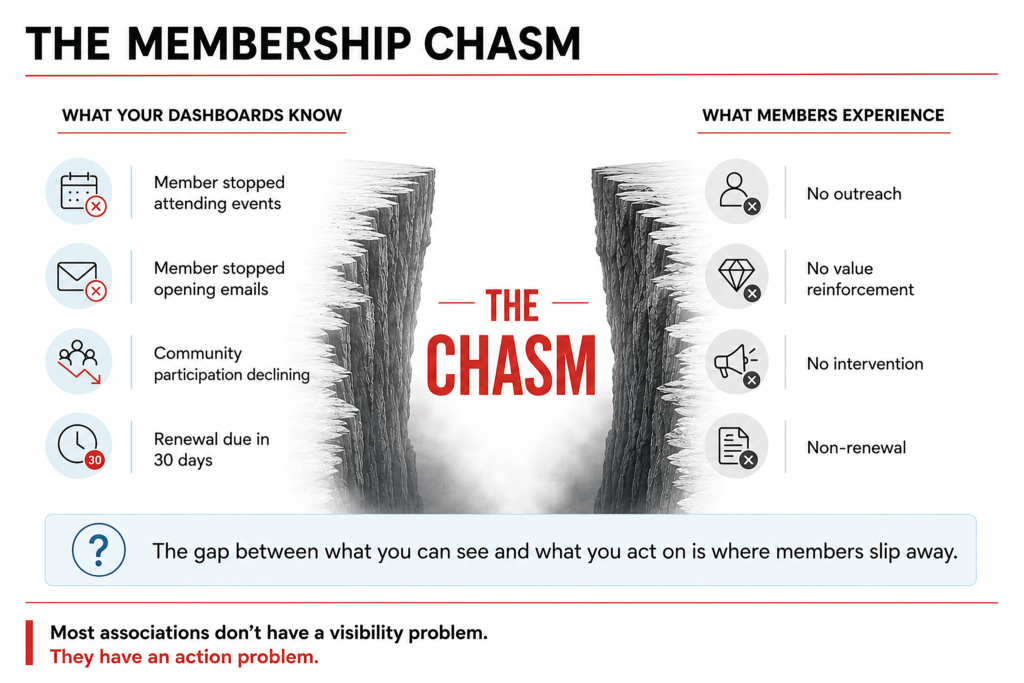
Most membership teams already know who stopped attending events, who stopped opening emails, and whose renewal is coming up next month. That information sits in an AMS, a CRM, or a marketing platform, usually accurate. The instinct, when a member quietly drifts away, is to assume something was missed, a signal that never surfaced, a report nobody read closely enough. But in most cases, nothing was missed at all. The decline was visible the entire time, on a dashboard someone genuinely looked at. The member still left anyway. That single fact means the usual fix, more visibility, more tracking, better reporting, was never going to be enough on its own.
The signal was never the problem. What happens after the signal appears is.
Is this actually a data problem?
Over the last decade, associations invested heavily in the technology meant to solve exactly this. AMS platforms, learning management systems, community platforms, event tools, email marketing suites and analytics dashboards layered on top of all of it. Each purchase came with a version of the same promise: better visibility into what members are actually doing, so teams can act before it is too late. In fairness, most of that promise was delivered. Associations today can see engagement patterns that would have been invisible a decade ago. And disengagement still keeps slipping through anyway, which tells you the bottleneck has moved. It is no longer about collecting the signal.
It is about what an organization can actually do with it once it appears.
Why does more reporting not fix it?
Picture a sequence that will feel familiar to almost anyone who has run a membership program. A member’s event attendance starts to taper off. A dashboard quietly flags the decline. Someone notices it during a weekly report review. An outreach task gets created and added to a list. Then a different priority takes over that same week, a conference deadline, a board request, a technical fire somewhere else. The task slips. The renewal date arrives before the outreach ever happens, and the member does not renew. Nothing in that sequence failed technically, the dashboard, the report, and the meeting all did exactly what they were built to do. More dashboards, more granular reports, none of that would have closed the gap in this story.
The gap was never in the seeing. It was in everything that was supposed to happen next.
Why does the member experience break between departments?
Inside most associations, responsibility for the member relationship is divided in a way that makes perfect organizational sense. Marketing owns communications, events own conference logistics, learning owns course completion and certification and membership owns the renewal conversation itself. Each of those teams typically does its part well, measured against its own goals and its own dashboard.
The complication is that members never experience the association this way. They do not think in departments, they experience one continuous relationship, and when a signal has to travel from one team’s dashboard to another team’s action item, ownership of that moment has a way of quietly disappearing in the handoff. Nobody did anything wrong. Nobody was actually responsible for the whole thing either, and that is often exactly where the member slips through.
Does it matter how fast we respond?
Disengagement is almost never sudden. It builds gradually, in small increments that are individually easy to dismiss, over the course of weeks or sometimes months. A missed event here or a skipped newsletter there or a slightly quieter presence in an online community. Caught early, most of those signals are simple to reverse with a single relevant, well-timed touchpoint. Left untouched for a few more weeks, they compound, and reversing them starts to require far more effort for far less certain results. This is why the speed of response tends to matter more, in practice, than the precision of the original report.
A team that acts on a rough, early signal within days will usually outperform a team that waits for a perfectly confirmed signal a month later.
So what exactly is the Membership Chasm?
The Membership Chasm is the name for the distance in between: the gap between what an organization already knows about a member and what it is actually able to do with that knowledge before the window to act closes. Every association runs into this gap somewhere, whether or not it has a name for it yet. Some experience it only occasionally, in a handful of members who slip through each cycle. Others have, often without quite realizing it, built their entire operating model around absorbing its consequences rather than closing it.
Recognizing the gap for what it is tends to be the first real step toward doing something about it, because once a team starts looking for it, it shows up almost everywhere, not in the dashboards, but in the quiet space between the moment insight appears and the moment someone actually acts on it.
What should membership leaders take away from this?
None of this means an association is doing anything wrong. Most teams are working hard, inside systems that were built with good intentions, staffed by people who genuinely care about retention. The gap exists anyway, quietly, in the space between a signal and a response, and it will keep costing renewals until an organization deliberately decides to close it rather than manage around it.
That is precisely where the conversation around retention is heading next.
Frequently Asked Questions (FAQs)
1) What is the Membership Chasm?
It is the distance between what an organization knows about a member and what it can realistically act on before the opportunity passes.
2) Is this the same as a data or reporting problem?
No. Most associations already collect more data than they can act on, so adding more reports rarely closes the gap.
3) Why do dashboards fail to prevent member churn?
A dashboard can surface a signal accurately and still not trigger timely action, since visibility and response are two separate steps.
4) What causes the gap between insight and action?
Competing priorities, manual workflows, and unclear ownership usually slow the handoff between noticing a signal and acting on it.
5) Is this only a problem for large associations?
No, it shows up at any size, though it is often easier to spot in smaller teams where capacity constraints are more visible.
6) How early do disengagement signals usually appear?
Signals like declining event attendance or falling email opens typically build gradually over weeks or months before a renewal is due.
7) Why does cross-department ownership matter?
Members experience one continuous relationship, so when responsibility passes between teams, ownership of the critical moment can quietly disappear.
8) Is this a technology problem or a process problem?
Mostly process. Most organizations already own the technology needed to see the signal, the friction sits in what happens next.
9) Can more staff solve the chasm?
It can help, but adding headcount without addressing workflow and ownership issues tends to only partially close the gap.
10) What is the cost of delayed action on a disengaged member?
The longer a signal sits untouched, the less likely a member is to respond to outreach by the time it finally happens.
11) How do I know if my organization has a Membership Chasm?
If your team can point to a member who disengaged despite a visible signal, the gap exists somewhere in your operating model.
12) Does this only affect renewals?
No, the same gap shows up in learning completion, event attendance, and volunteer engagement wherever a signal sits unactioned.
13) What is the first step to closing the gap?
Mapping where signals currently stall between detection and outreach is usually the most useful starting point.
14) Does this apply to smaller membership teams too?
Yes, smaller teams often feel the gap most acutely since fewer people are covering the same volume of signals.
15) Where can I learn more about how organizations are closing this gap?
The full Membership Chasm brief goes deeper into what is driving this shift and how leading associations are responding.