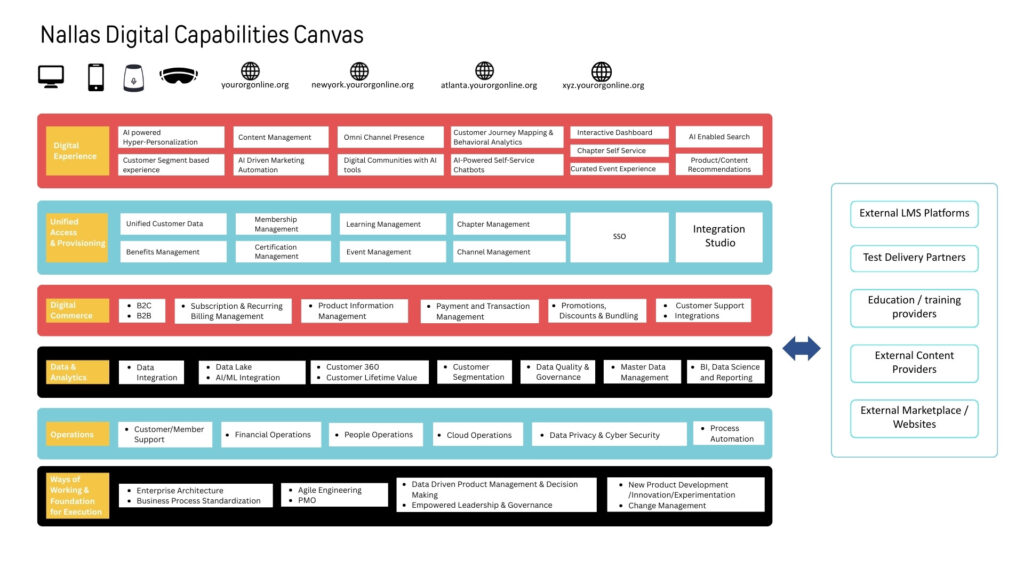
1)Digital Experience
This is the visible layer; member portals, donor journeys, event registration systems and omnichannel communication platforms. It shapes how stakeholders interact with the organization.
2)Core Digital Systems
These include CRM, ERP, learning management systems, finance platforms and membership management systems. They power transactions, workflows, and reporting.
If these systems are outdated or poorly integrated, digital initiatives struggle to take off.
3)Digital Commerce
Commerce includes renewals, certifications, event monetization and other revenue infrastructure. Efficient digital commerce directly impacts financial sustainability.
Without integration between commerce and core systems, revenue visibility becomes limited.
4)Data and Analytics
Unified data architecture enables leadership to move from reactive reporting to predictive insight. This layer includes data lakes, dashboards, data governance frameworks and integration standards.
Data maturity is the prerequisite for responsible AI adoption.
5)Operations
Digital transformation must translate into operational efficiency. This dimension focuses on process redesign, workflow automation and cross-functional coordination.
Technology without operational alignment creates friction.
6)Foundational Ways of Working
The foundation of the Canvas is organizational culture and governance. Leadership alignment, change management, cybersecurity discipline and board-level oversight determine whether transformation sustains momentum.
Even the most advanced systems fail without cultural readiness.
Integration Studio connects internal platforms with external service providers, ensuring that data flows seamlessly across systems and members experience a unified digital journey rather than fragmented interactions.
McKinsey’s research on AI adoption shows that organizations scaling AI successfully invest heavily in governance and data maturity alongside experimentation. The same principle applies to nonprofit digital transformation.
The Nonprofit Digital Capability Canvas ensures that:
- AI is introduced only after data governance matures
- Experience enhancements are supported by integrated systems
- Operational redesign accompanies technology upgrades
- ROI is measured at each capability layer
Transformation becomes predictable when capability gaps are addressed early.
How Nonprofits Can Leverage the Digital Capability Canvas
Nonprofit technology leaders can use the Canvas as a diagnostic and planning tool.
Start by mapping current initiatives across the seven dimensions. Identify capability imbalances. For example, strong front-end experience but weak data governance. Sequence modernization efforts to strengthen foundational layers before scaling advanced capabilities.
Align each dimension with measurable KPIs tied to mission objectives. Embed governance and leadership oversight early. Review progress periodically to ensure capabilities evolve collectively rather than in isolation.
The Canvas transforms digital transformation from a collection of projects into a coordinated maturity journey.
Conclusion
Nonprofit digital maturity is not achieved through experimentation alone. It requires structured capability development across systems, data, AI, operations, and governance.
The Digital Capability Canvas provides a practical framework to ensure modernization efforts are sequenced, measurable, and aligned with mission impact.
Nonprofits that build capabilities in the right order do not just modernize, they accelerate sustainably.
FAQs
1)What is the Nonprofit Digital Capability Canvas?
The Digital Capability Canvas is a structured framework for nonprofit digital transformation. It organizes modernization into seven interdependent dimensions: digital experience, core systems, commerce, data and analytics, AI, operations, and foundational governance.
2)How does the Nonprofit Digital Capability Canvas improve nonprofit digital maturity?
The Canvas ensures that capabilities evolve in the correct sequence. Instead of deploying isolated tools, nonprofits strengthen foundational systems and data governance before scaling AI and advanced analytics.
3)Why is capability sequencing important in nonprofit digital transformation?
Sequencing prevents fragmentation. AI initiatives require governed data. Experience improvements require integrated core systems. Without sequencing, technology investments fail to scale or deliver ROI.
4)How can nonprofits assess their digital capability maturity?
Organizations can map existing initiatives against the seven dimensions of the Canvas to identify gaps. This assessment reveals where modernization is unbalanced and which foundational layers require strengthening.
5)What role does AI play in the Digital Capability Canvas?
AI functions as a strategic enabler within the Canvas. It supports automation, predictive analytics, and personalization, but only after data governance and system integration maturity are achieved.
6) How does the Digital Capability Canvas support measurable ROI?
By aligning each capability layer to specific KPIs and mission objectives, the Canvas ensures that digital transformation progress is trackable and accountable at every stage.
7) Who should use the Digital Capability Canvas?
The framework is designed for nonprofit CIOs, CTOs, digital transformation leaders, and executive teams seeking a structured, governance-aligned approach to modernization.