What happens when members can access your knowledge for free?
That is the uncomfortable question many associations and membership organisations are facing today. Industry insights that once sat behind memberships are now available through AI search engines, online communities, YouTube explainers, LinkedIn creators, and open learning platforms. Members no longer rely solely on associations for access to information.
The pressure is already visible across the sector. Nearly one-third of associations now cite membership retention and engagement as a top challenge, while 90% of nonprofits operate three or more core technology applications, creating increasingly fragmented operational environments.
At the same time, AI adoption is accelerating faster than operational readiness. AI adoption among association professionals doubled year-over-year to 39%, yet only 5% of nonprofit organisations report having a formal AI strategy in place.
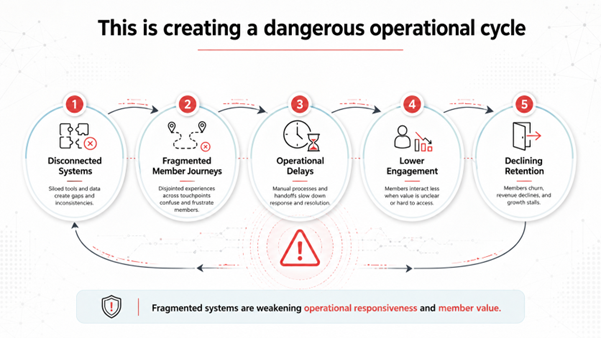
The result is disconnected member experiences, operational inefficiencies, and declining engagement. Members increasingly expect personalised engagement, proactive support, intelligent recommendations, and seamless digital experiences, yet many organisations still depend on manual workflows, spreadsheets, and siloed systems.
So how can associations restore member value in the AI era?
The answer may lie in multi-agent systems and agentic AI for associations.
Why are associations struggling with member engagement?
The issue is not a lack of technology but the fact that most systems do not communicate intelligently with one another.
Research across the nonprofit and membership sector consistently highlights the same challenges: fragmented systems, manual processes, poor visibility across workflows, rising operational complexity, and growing pressure on already stretched teams.
Why are members disengaging?
Most associations still operate reactively. A disengaged member is often identified only during renewal season, event recommendations remain generic, learning pathways are disconnected from member interests, and support teams lack contextual visibility. Meanwhile, operations teams are overwhelmed by administrative work.
This is why AI workflow automation and AI-powered association management are becoming critical operational priorities.
Can associations reverse this trend?
Associations already possess one major advantage: trusted member relationships and rich organisational data.
Most membership organisations already have:
-
- Member lifecycle data
- Event participation history
- Certification and learning records
- Engagement analytics
- Financial and renewal information
- Community interaction signals
The problem is not data scarcity. The problem is orchestration. Associations need systems capable of continuously coordinating workflows, engagement, support, and operational intelligence across departments.
This is where AI adoption strategy becomes important.
The next phase of digital transformation in associations is not about adding another standalone platform but about building an intelligent operational layer using agentic workflow automation.
That operational layer is increasingly being powered by multi-agent AI systems.
What are multi-agent AI systems in associations?
A multi-agent AI system is a network of specialised AI agents working together across organisational workflows.
Instead of one isolated chatbot, associations can deploy multiple AI agents for member engagement, operations, learning, support, finance, and strategic planning. Each AI agent performs a specialised function while continuously sharing intelligence across the organisation.
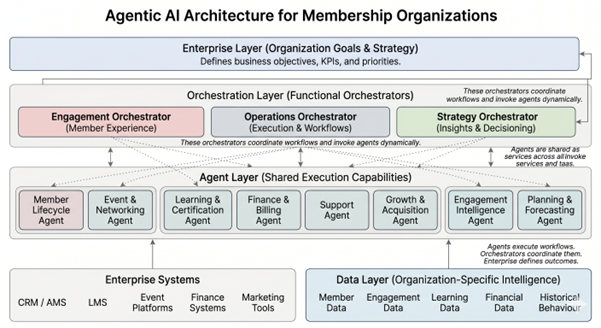
So how does this architecture work for membership organisations?
1. Enterprise Layer
The Enterprise Layer defines organisational priorities such as member retention, revenue growth, engagement, and programme adoption that guide the behaviour of the AI ecosystem.
2. Orchestration Layer
The Orchestration Layer coordinates workflows across departments and dynamically activates the right AI agents based on operational context and member activity.
3. Agent Layer
The Agent Layer contains specialised AI agents for functions like member engagement, learning and certification, event experience and member support that execute operational tasks autonomously.
4. Data and Enterprise Systems Layer
The Data and Enterprise Systems Layer connects existing platforms such as CRM, AMS, LMS, finance, marketing, and event systems into a unified intelligence environment.
How can Nallas help you transform into a multi-agent AI system?
Nallas operates as an Agentic AI layer for membership organisations which integrates existing systems and orchestrates them to function as a coordinated intelligence ecosystem instead of disconnected software applications.
How would an AI agent system improve member engagement?
Consider a member who has been disengaged for 30 days. In most associations, nobody notices.
In an multi-agent AI system for member engagement, the system continuously monitors behavioural signals such as:
- No recent learning activity
- Declining email engagement
- No event registrations
- Reduced portal logins
The Strategy Orchestrator identifies and flags this as churn risk. The system then automatically triggers relevant agents and coordinates actions:
- The Learning Agent recommends a relevant certification pathway
- The Event Agent surfaces a curated event agenda and networking opportunities
- The Support Agent drafts contextual outreach
The result is proactive engagement before disengagement becomes permanent. This is the real value of agentic AI for membership organisations: not merely faster workflows, but smarter operational coordination.
What does this mean for a membership COO?
For operations leadership, multi-agent systems represent more than another AI trend; they represent a new operational model.
A successful AI adoption strategy can help associations:
- Improve member retention
- Reduce manual administrative work
- Increase staff productivity
- Deliver personalised member journeys
- Improve reporting visibility
- Coordinate cross-functional workflows
- Strengthen operational scalability
Research increasingly shows that organisations generating meaningful AI value are redesigning workflows and not merely adding isolated AI tools.
This is particularly important for associations facing staffing constraints, growing member expectations, and operational complexity.
The future of association management may not depend on acquiring more software, but on how intelligently existing systems are orchestrated.
Final Thought
Members no longer pay simply for access to information. They pay for relevance, outcomes, and intelligent experiences that help them grow professionally, connect meaningfully, and navigate complexity.
Associations that continue operating through disconnected systems and reactive workflows risk becoming operationally invisible.
Multi-agent systems offer a different path. One where AI agents for associations continuously coordinate engagement, operations, insights, and support across the organisation.
The next competitive advantage for membership organisations will not come from owning more platforms. It will come from building an intelligent operating layer that makes every existing platform work better.
Frequently Asked Questions (FAQs)
1. What are multi-agent AI systems for associations?
Multi-agent AI systems for associations are networks of specialised AI agents that work together across member engagement, operations, learning, events, support, finance, and analytics workflows. Instead of functioning as isolated AI tools, these agents coordinate actions across existing association systems to improve operational efficiency and member experience.
2. How is agentic AI different from traditional automation in associations?
Traditional automation executes predefined tasks based on static rules. Agentic AI systems continuously analyse context, coordinate workflows dynamically, and trigger intelligent actions across multiple systems. This allows associations to move from reactive operations to proactive member engagement and operational decision-making.
3. Why are associations struggling with member engagement today?
Many associations operate through fragmented systems that create disconnected member journeys. Learning platforms, CRM systems, event tools, and engagement systems often operate independently, making it difficult to deliver personalised and timely member experiences. Members increasingly expect proactive support, personalised recommendations, and seamless digital interactions.
4. What role does AI play in membership retention?
AI helps associations identify disengagement signals early by monitoring behavioural patterns such as reduced event participation, declining learning activity, or lower email engagement. AI agents can then automatically coordinate personalised outreach, content recommendations, and engagement strategies before members disengage permanently.
5. Can multi-agent AI systems integrate with existing AMS and CRM platforms?
Yes. Multi-agent AI systems are designed to integrate with existing AMS, CRM, LMS, finance, marketing, and event platforms. The goal is not to replace current systems but to create an intelligent orchestration layer that enables them to work together more effectively.
6. What are the benefits of agentic AI for membership organisations?
Agentic AI can help associations:
- Improve member retention
- Reduce manual administrative work
- Increase operational efficiency
- Deliver personalised member experiences
- Improve cross-functional coordination
- Strengthen reporting and forecasting
- Scale operations without proportionally increasing staffing costs
7. How do AI agents improve member engagement in associations?
AI agents continuously monitor engagement signals and member behaviour across platforms. For example, if a member stops engaging for 30 days, the system can automatically trigger learning recommendations, event invitations, contextual outreach, and support interventions to re-engage the member proactively.
8. What is an AI orchestration layer in association management?
An AI orchestration layer coordinates workflows between different AI agents and enterprise systems. It acts as the operational control layer that aligns member engagement, operations, support, and strategic workflows with organisational priorities such as retention, growth, and programme participation.
9. Are multi-agent AI systems replacing association staff?
No. Multi-agent AI systems are designed to augment staff capabilities rather than replace them. By automating repetitive administrative work and coordinating workflows intelligently, AI enables operations teams to focus more on strategy, member relationships, programme development, and high-value engagement activities.
10. Why are multi-agent systems considered the future of association operations?
Associations are facing growing operational complexity, rising member expectations, and increasing pressure to demonstrate value. Multi-agent systems provide a scalable operational model that connects fragmented systems, enables proactive engagement, and helps associations deliver more intelligent and personalised member experiences at scale.