Why Many Membership Organizations Still Struggle with Member Engagement
Membership organizations have more technology, more member data, and more engagement tools than ever before. Modern association management systems (AMS), CRM platforms, learning management systems (LMS), event platforms, and marketing tools now capture engagement activity across nearly every stage of the member lifecycle.
But despite all of this visibility, many associations still struggle to:
- recognize disengagement before it becomes a retention problem,
- coordinate timely outreach across teams,
- and create member experiences that feel personal, connected, and relevant.
The issue is no longer just about having access to data.
For many organizations, the real challenge is turning visibility into action.
Across AMS platforms, CRM systems, learning environments, communication tools, and engagement platforms, teams can often see what members are doing. What remains difficult is responding to those signals quickly, consistently, and in a coordinated way.
As expectations continue shifting toward AI-powered personalization, seamless digital experiences, and proactive engagement, operational responsiveness is becoming a major differentiator between organizations that adapt and those that react too slowly.
To better understand this shift, we mapped four common operational states that are emerging across modern membership organizations.
Why This Framework Matters for Associations
Many association digital transformation initiatives focus heavily on:
- centralizing member data,
- improving reporting visibility,
These investments absolutely matter. But visibility alone does not automatically create better member engagement or stronger member retention.
A membership organization can: | …while still struggling to: |
Consolidate member data | Coordinate engagement across systems |
Modernize its technology stack | Identify disengagement risk early |
Improve dashboards and analytics | Operationalize member lifecycle management |
Automate isolated workflows | Trigger timely and contextual interventions |
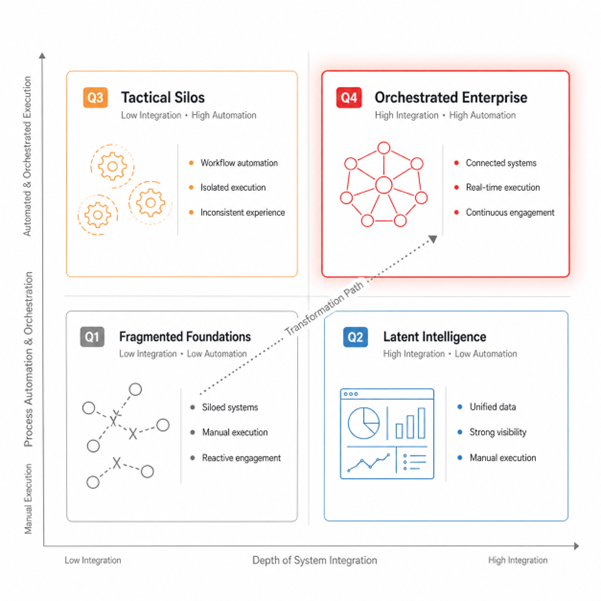
The Four States of the Membership Operating Gap framework helps associations identify where operational execution begins to break down and how those gaps affect engagement, retention, and long-term organizational relevance.
What Is the Membership Operating Gap?
The Membership Operating Gap is the disconnect between engagement visibility and operational responsiveness. In simple terms, it describes the difference between knowing what members are experiencing and being able to respond effectively in real time.
The framework evaluates organizations across two dimensions:
- Depth of System Integration
How connected engagement systems are across the member lifecycle, including AMS, CRM, learning, support, event, and communication platforms.
- Execution Process Automation and Orchestration
How effectively engagement signals translate into coordinated operational response, engagement automation, and personalized member outreach.
Together, these dimensions create four distinct operational states.
Q1 — Fragmented Foundations
Low Integration | Low Automation
In this operational state:
- member data lives across disconnected systems,
- teams rely heavily on spreadsheets and manual reporting,
- engagement efforts are mostly reactive,
- and visibility into member behavior is delayed or incomplete.
Operationally, teams spend more time gathering information than acting on it.
What This Means
Organizations in this stage often recognize disengagement only after participation has already declined significantly. Renewal risk becomes visible late because engagement signals remain scattered across systems and departments.
As a result, the member experience can feel inconsistent from one interaction to the next because teams lack a unified view of the member journey.
Common Indicators
- AMS, CRM, LMS, and event systems operate independently
- Reporting cycles are periodic instead of continuous
- Manual exports drive operational decisions
- Member outreach is campaign-driven rather than contextual
Q2 — Latent Intelligence
High Integration | Low Automation
In this state:
- member data becomes more centralized,
- engagement visibility improves,
- dashboards and analytics become more sophisticated,
- but operational execution still depends heavily on manual coordination.
Organizations can increasingly identify engagement decline but still struggle to respond quickly.
What This Means
This is often the most misleading stage of digital maturity.
On the surface, the organization appears advanced because reporting and visibility improve dramatically. But behind the scenes, engagement interventions still rely on:
- and delayed operational response.
The organization has intelligence, but not true responsiveness.
Teams can see the problem, yet operational orchestration remains limited.
Common Indicators
- Mature enterprise dashboards and reporting
- Integrated engagement systems or centralized data environments
- Teams still coordinating interventions manually
- Engagement actions remain periodic and campaign-based
Q3 — Tactical Silos
Low Integration | High Automation
In this state:
- automation exists within individual departments,
- workflows become faster at the local level,
- but systems remain disconnected across the broader member lifecycle.
Different teams automate independently, but engagement continuity across touchpoints is still limited.
What This Means
Organizations in this stage often improve efficiency within specific departments while unintentionally creating fragmented member experiences.
For example:
- support platforms may automate responses,
- learning systems may personalize recommendations,
- event systems may trigger communications,
…but these experiences remain disconnected from one another operationally.
The result is isolated efficiency without coordinated member engagement.
Common Indicators
- Department-level automation initiatives
- Isolated engagement workflows
- Independent communication journeys
- Inconsistent experiences across platforms
Q4 — Orchestrated Enterprise
High Integration | High Automation
In this state:
- systems are connected across the member lifecycle,
- behavioral signals trigger coordinated actions across platforms,
- engagement becomes continuous instead of episodic,
- and operational responsiveness becomes adaptive and contextual.
This is where organizations begin shifting from fragmented engagement execution toward true engagement orchestration.
What This Means
Organizations operating in this state rely less on periodic campaigns and more on continuously adaptive engagement models.
Behavioral signals across:
…can trigger coordinated operational responses automatically across systems.
As a result, member experiences become:
- and more connected across interactions.
Common Indicators
- Cross-platform engagement orchestration
- Contextual engagement automation
- Real-time operational responsiveness
- Coordinated member journeys across systems
Why Many Associations Become Stuck
Most membership organizations do not stay in Q1 forever.
Over time, many associations successfully modernize systems, centralize engagement data, and improve visibility. However, digital maturity often stalls between visibility and execution.
Organizations frequently invest in:
…without fully operationalizing coordinated engagement responsiveness.
This creates an execution gap where engagement intelligence exists, but adaptive operational response does not. As member expectations continue evolving, this gap becomes increasingly visible through declining engagement, inconsistent experiences, and retention challenges.
The Shift Underway in Association Digital Transformation
Membership organizations are steadily moving from:
- periodic engagement toward continuous engagement,
- isolated workflows toward coordinated orchestration,
- reporting visibility toward operational responsiveness,
- and siloed systems toward connected member lifecycle management.
Importantly, this shift is not necessarily about replacing existing association technology platforms.
Instead, many organizations are exploring how their current AMS, CRM, LMS, event, communication, and support systems can work together more intelligently through orchestration layers and AI-powered member engagement solutions.
The next phase of association digital maturity may not be defined by how much member data an organization collects, but by how effectively engagement signals translate into timely, personalized, and coordinated action.
Final Perspective
Today’s members increasingly expect experiences that feel:
- and seamless across interactions.
Adaptive engagement orchestration is quickly becoming a defining capability for associations looking to improve member engagement, strengthen member retention, and deliver long-term member value at scale.
The organizations that operationalize this shift earliest may ultimately be the ones best positioned to remain relevant, responsive, and competitive in the evolving membership economy.
Frequently Asked Questions (FAQs)
- What is the Membership Operating Gap in associations?
The Membership Operating Gap refers to the disconnect between engagement visibility and operational responsiveness within membership organizations. Many associations can see member behavior through AMS, CRM, LMS, and event platforms, but struggle to coordinate timely and contextual engagement actions across systems.
- Why do membership organizations struggle with member engagement despite having modern technology?
Many membership organizations have invested heavily in association management systems, CRM platforms, learning tools, and engagement technologies. However, these systems often operate independently, creating fragmented workflows and disconnected member experiences. The issue is no longer data availability but operational orchestration.
- What are the four states of the Membership Operating Gap framework?
The framework identifies four operational maturity states for associations:
- Q1 — Fragmented Foundations
- Q4 — Orchestrated Enterprise
These states measure how effectively organizations integrate systems and operationalize engagement responsiveness across the member lifecycle.
- What is the difference between system integration and engagement orchestration?
System integration focuses on connecting platforms such as AMS, CRM, LMS, and event systems. Engagement orchestration goes further by coordinating operational actions, workflows, and member interventions dynamically across those systems based on behavioral signals and engagement data.
- Why do many associations get stuck between visibility and execution?
Many organizations successfully improve dashboards, analytics, reporting, and data centralization but still rely on manual operational coordination. This creates a gap where teams can identify engagement issues but cannot respond quickly or consistently enough to improve member retention and engagement outcomes.
- What does an “Orchestrated Enterprise” look like in membership organizations?
An Orchestrated Enterprise operates through connected systems and coordinated engagement workflows. Behavioral signals from learning platforms, events, certifications, support systems, and communications can automatically trigger contextual member outreach and operational responses in real time.
- How does the Membership Operating Gap affect member retention?
When engagement signals remain fragmented or operational response is delayed, associations often identify disengagement too late. This leads to inconsistent member experiences, weaker engagement continuity, and increased renewal risk. Organizations with stronger orchestration capabilities can respond proactively before disengagement becomes permanent.
- What role does AI play in association operational orchestration?
AI-powered engagement orchestration helps associations identify behavioral patterns, automate contextual outreach, coordinate workflows across systems, and improve operational responsiveness. AI enables organizations to move from periodic campaign-based engagement toward continuously adaptive member engagement models.
- Can associations improve member engagement without replacing existing systems?
Yes. Many associations are improving member engagement by connecting existing AMS, CRM, LMS, event, and communication platforms through orchestration layers and workflow automation rather than replacing their technology stack entirely. The focus is increasingly on operational coordination rather than software replacement.
- Why is operational responsiveness becoming important for associations?
Member expectations are evolving toward experiences that feel personalized, proactive, contextual, and seamless across interactions. Associations that can operationalize timely engagement and coordinated member journeys are more likely to improve member retention, sustain relevance, and deliver long-term member value at scale.