AI for Associations: What Comes First, Membership Growth or Technology Investment?
Author: Jerry Papadatos, Giridhar Gopal Warrier
- June 2, 2026
- 5 Mins read
Share us on:
For years, membership organizations approached growth and technology as separate initiatives. First, associations focused on increasing membership, improving retention, and generating revenue. Technology investments came later, once budgets allowed.
Today, that approach is becoming increasingly difficult to sustain.
Association leaders face rising member expectations, growing operational complexity, and increasing pressure to deliver measurable member value. At the same time, artificial intelligence (AI), workflow automation, and data-driven decision-making are creating new opportunities to improve member engagement and member retention.
As a result, many organizations are asking an important question:
Can AI for associations and digital transformation initiatives actually drive membership growth, or should growth come first?
Why Are Membership Organizations Struggling to Grow?
Most membership organizations already possess significant amounts of member data.
Association management systems (AMS), CRM platforms, learning management systems (LMS), event platforms, and community engagement tools generate valuable insights about member behaviour every day.
Organizations can typically track:
- Member engagement levels
- Event participation
- Certification and learning activity
- Community involvement
- Membership renewal history
- Volunteer participation
- Communication preferences
Yet many associations continue to struggle with member retention, member engagement, and long-term membership growth.
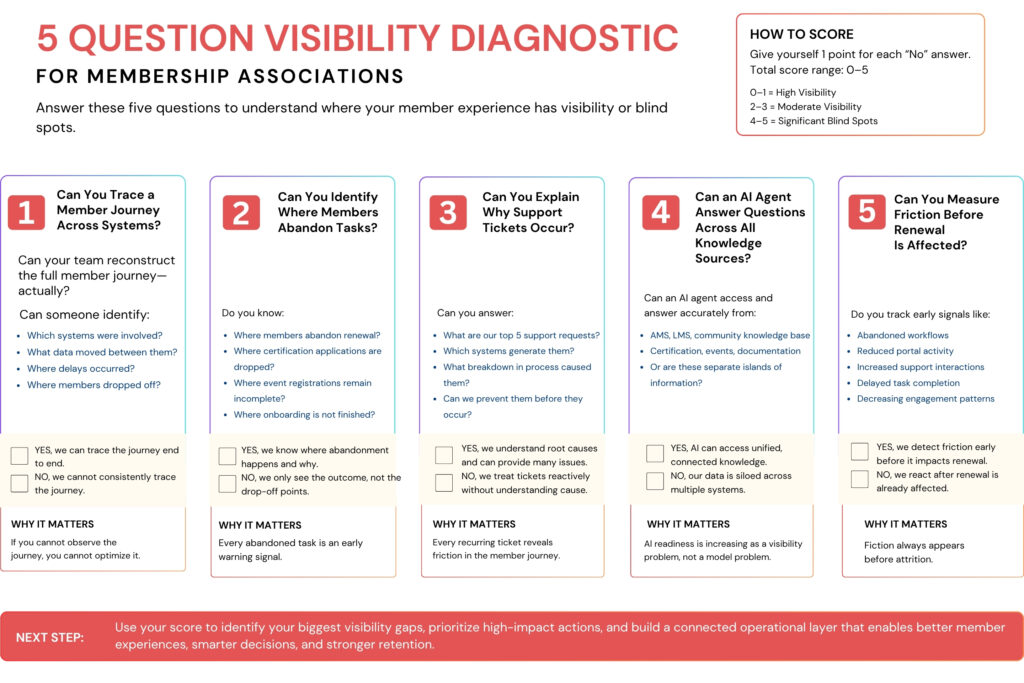
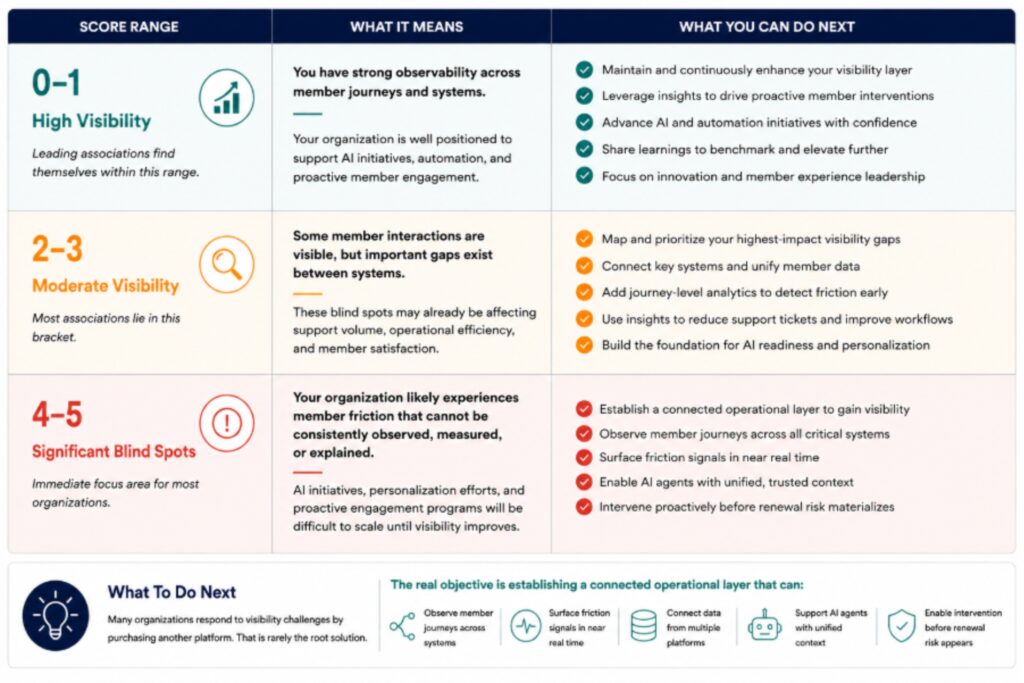
The challenge is rarely a lack of data. More often, the challenge is converting data into action. This is one of the most common association operational challenges facing membership organizations today.
Why Is Member Data Difficult to Act On?
Over time, many organizations have built complex technology ecosystems consisting of AMS platforms, CRM systems, learning platforms, event management software, and reporting tools.
While each platform serves an important purpose, the result is often fragmented data and disconnected workflows.
Association data silos create several problems:
- Member engagement signals are difficult to identify.
- Renewal risks remain hidden.
- Staff spend time manually reconciling data.
- Personalized member outreach becomes difficult.
- Reporting is reactive instead of predictive.
This is why association data integration and association data modernization have become strategic priorities for many organizations.
Without a connected view of the member journey, valuable opportunities to improve member retention and member engagement are frequently missed.
How Are Member Expectations Changing?
Members increasingly expect the same digital experiences they receive from commercial organizations.
Whether they interact with Amazon, Netflix, LinkedIn, or other digital platforms, people have become accustomed to personalized recommendations, timely communications, and frictionless experiences.
As a result, today’s members expect:
- Personalized communications
- Relevant educational recommendations
- Seamless event experiences
- Faster support responses
- More relevant content
- Recognition of their interests and engagement history
Meeting these expectations manually becomes increasingly difficult as organizations grow.
This is one reason why AI powered member experience initiatives and AI powered community engagement strategies are receiving increased attention across the association sector.
How Can AI for Associations Support Membership Growth?
The conversation around AI for associations is rapidly evolving.
Initially, many organizations viewed AI primarily as a productivity tool. Today, associations are beginning to see AI as a strategic capability that can improve engagement, retention, and operational performance.
AI for member engagement can help organizations:
- Identify disengaged members earlier
- Deliver personalized member journeys
- Recommend relevant programs and events
- Improve member communications
- Support membership growth strategies
- Strengthen member retention initiatives
Rather than replacing staff, AI helps teams focus their time on higher-value activities that improve the member experience.
For many organizations, AI powered association management is becoming a critical component of long-term growth.
What Role Do AI Agents Play in Association Operations?
One of the most important developments in the industry is the emergence of AI agents for associations.
Unlike traditional automation tools that execute predefined tasks, AI agents can analyze information, make recommendations, and trigger actions across multiple systems.
Examples include:
- AI agents for member engagement
- AI agents for fundraising
- AI powered workflow automation
- AI driven operational workflows
- AI enabled member service operations
These capabilities help organizations reduce manual work while improving responsiveness and consistency.
As a result, AI for association operations is moving beyond experimentation and becoming a practical tool for operational transformation.
Why Are Association Leaders Investing in AI and Digital Transformation?
Many organizations are discovering that growth and technology are no longer separate conversations. Association digital transformation is increasingly focused on building organizational capabilities that support growth.
Leading membership organizations are investing in:
- Association data strategy
- Association data integration
- AI readiness frameworks
- AI operating models for associations
- AI governance for associations
- AI orchestration platforms
- AI powered operational transformation
The goal is not simply efficiency. It is creating an organization that can deliver greater value to members at scale.
Is Technology Investment Really Separate from Membership Growth?
For many years, organizations treated technology as a support function. Today, that perspective is changing.
AI for associations, association enterprise automation, and AI powered workflow automation are helping organizations improve member experiences, strengthen retention, and operate more efficiently.
Membership growth creates resources for investment. Technology creates capabilities that support growth. Increasingly, the two work together.
Rather than asking whether technology should follow growth, association leaders may need to ask a different question:
What AI capabilities, operational workflows, and member engagement systems do we need today to achieve the membership growth goals we have tomorrow?
What Should Associations Do Next?
Organizations do not need to launch a large-scale transformation programme overnight. A more practical approach is to:
- Assess current association data infrastructure and data silos.
- Conduct an AI maturity assessment.
- Develop an AI strategy for associations aligned to member outcomes.
- Prioritize AI use cases for associations that improve member engagement and member retention.
- Build a roadmap for association digital transformation and operational modernization.
The Bottom Line
The debate between membership growth and technology investment is becoming increasingly outdated.
AI for associations, AI powered member experience initiatives, and intelligent association operations are changing how organizations attract, engage, and retain members.
Organizations that invest in the right capabilities today will be better positioned to improve member engagement, strengthen member retention, and achieve sustainable membership growth in the future.
Frequently Asked Questions (FAQs)
1. What is AI for associations?
AI for associations refers to the use of artificial intelligence technologies to improve member engagement, member retention, operational efficiency, data analysis, and decision-making within membership organizations.
2. How can AI help increase membership growth?
AI can identify engagement patterns, personalize member experiences, automate communications, predict renewal risks, and recommend relevant programs, helping associations attract and retain more members.
3. What are the benefits of AI for member engagement?
AI helps associations deliver personalized content, targeted communications, event recommendations, and proactive outreach, resulting in stronger member relationships and higher engagement levels.
4. Can AI improve member retention?
Yes. AI can analyze member behaviour, identify at-risk members, trigger retention campaigns, and provide insights that help organizations improve renewal rates and long-term member loyalty.
5. What are AI agents for associations?
AI agents are intelligent systems that can perform tasks, analyze information, make recommendations, and automate workflows across multiple association platforms and systems.
6. Why is association data integration important for AI?
AI performs best when data is connected across AMS, CRM, LMS, event, and community platforms. Integrated data provides a complete view of the member journey and enables more accurate insights.
7. What is association digital transformation?
Association digital transformation is the process of modernizing technology, workflows, data management, and member experiences to improve organizational performance and member value.
8. How do AI-powered member experiences benefit associations?
AI-powered member experiences provide personalized recommendations, relevant content, faster support, and tailored communications that increase member satisfaction and engagement.
9. What is an AI maturity assessment for associations?
An AI maturity assessment evaluates an organization’s readiness to adopt AI by reviewing data quality, technology infrastructure, governance, processes, and staff capabilities.
10. How can small associations start using AI?
Small associations can begin with simple use cases such as automated member communications, AI-powered content recommendations, chatbot support, and engagement analytics before expanding to more advanced applications.
11. What role does AI play in association operations?
AI helps automate repetitive tasks, streamline workflows, improve reporting, support decision-making, and increase operational efficiency across departments.
12. Is AI replacing association staff?
No. AI is designed to augment staff capabilities by handling routine tasks and providing insights, allowing teams to focus on strategic initiatives and member relationships.
13. What are the biggest challenges to implementing AI in associations?
Common challenges include data silos, limited resources, lack of AI expertise, governance concerns, and uncertainty about where to begin with AI adoption.
14. How do associations create an effective AI strategy?
An effective AI strategy starts with clear business goals, a strong data foundation, prioritized use cases, governance policies, and a roadmap aligned with member outcomes and organizational objectives.
15. What is the future of AI in the association industry?
The future of AI in associations includes intelligent member engagement, predictive analytics, AI agents, automated workflows, personalized learning experiences, and data-driven decision-making that supports sustainable growth.
Authors

Jerry Papadatos
Director - Sales

Giridhar Gopal Warrier
Lead – Strategy
Recent Articles